Current Issue: Volume 1 |  Issue 3  |  Year 2025
Prelims: From the desk of the Editor

Institutional Subscription

Individual Subscription

Original Articles
Incidence of Unilateral Sensorineural Hearing Loss in a Tertiary Hospital in Northeastern India: A Retrospective Study
Sheena K. Gupta, Neizekhotuo Brian Shunyu, Hanifa Akhtar, Jijitha Lakshmanan, Nisha Kumar

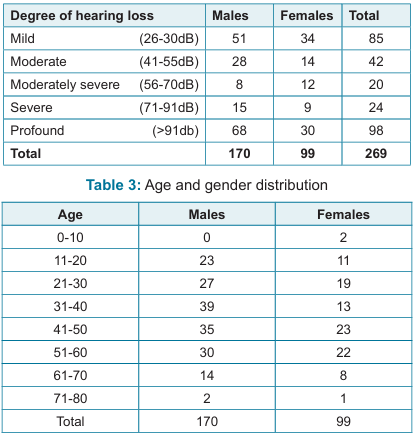
Background: Unilateral Sensorineural Hearing Loss (USNHL) poses a significant yet under-recognized health burden, impairing spatial sound localization and speech discrimination. While commonly overshadowed by bilateral hearing loss, its psychosocial and functional impacts warrant dedicated investigation.
Objective: To determine the incidence and severity of USNHL among patients.
Methods: A retrospective analysis of pure tone audiometry (PTA) data was conducted over 18 months (January 2024–June 2025) at AIIMS Guwahati. A total of 4000 patients were assessed for hearing complaints, and 269 were identified with USNHL. 
Results: Unilateral Sensorineural Hearing Loss accounted for 6.7% of all hearing loss cases reviewed. A male predominance (63.1%) was observed. The most affected age group was 41–50 years (21.5%), and the majority (36.4%) presented with profound hearing loss. Mild hearing loss was also noted (31.5%), that is indicates functional limitations even in early stages.
Conclusion: Unilateral Sensorineural Hearing Loss is often overlooked with considerable functional implications. Early identification through PTA and community awareness is essential. The study highlights the need for early identification and auditory rehabilitation tailored to unilateral hearing loss patients.
Keywords: Unilateral hearing loss, incidence and severity.
 
Review Articles
Nasopharyngeal carcinoma (NPC) is an epithelial malignancy with distinct epidemiology, high association with Epstein Barr virus (EBV), and very high sensitivity to radiotherapy and chemotherapy. Advances in radiology, radiotherapy, systemic chemotherapy, surgical salvage techniques for early recurrent cases, incorporation of immunotherapy have all significantly improved disease control and survival outcomes, making accurate staging increasingly important. In view of increasing good prognosis, the 9th version of the AJCC/UICC staging system introduces modifications to better align with modern treatment approaches and prognostic stratification.This review summarises highlights the recent updates in NPC staging and throw light on the advances in the management of locoregionally advanced, recurrent, and metastatic disease, with particular emphasis on immunotherapy. Emerging evidence supports plasma EBV-DNA as a useful biomarker in patients receiving anti–PD-1 therapy for prognosis and early detection of disease progression, although it is not yet incorporated into staging systems. New therapies such as antibody–drug conjugates and bispecific antibodies show promise but require further validation.
Keywords:
Nasopharyngeal carcinoma, latest AJCC updates, Immunotherapy, EBV DNA biomarker for recurrent NPC
Case Series
Osteoma of Temporal Bone: Case Series
Aakriti Chandra, Bhaswati Mahanta, Neizekhotuo Brian Shunyu, Hanifa Akhtar, Jijitha Lakshmanan
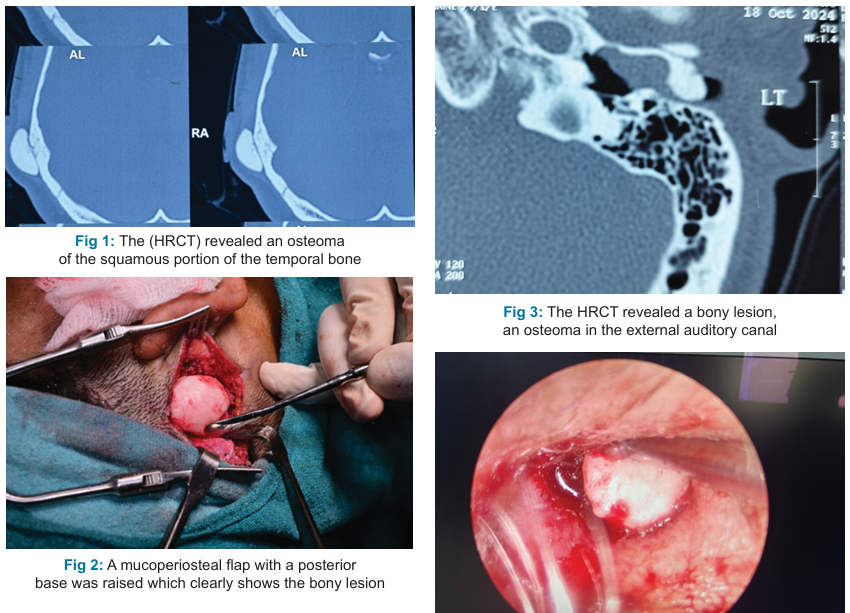
Osteomas are rare mesenchymal tumours which can be canalicular or extracanalicular.In our case series we are presenting both the type of osteomas of temporal bone to highlight the difference in presentation and management. EAC is the most common site of osteoma and squamous part of temporal bone involvement is rarely encountered. Clinical presentation of osteomas may range from painless bony mass in extracanalicular involvement to one causing tinnitus and ear discharge if present in the external auditory canal.The differential diagnosis include paget’s disease, osteosarcoma, keratosis obturans. A high-resolution computed tomography of the temporal bone is the investigation of choice.The diagnosis can only be confirmed by histopathology whereby we see mature lamellar and woven bone with harvesian canal.
Keywords: Osteomas,Temporal Bone, Extra Canalicular.
Case Reports
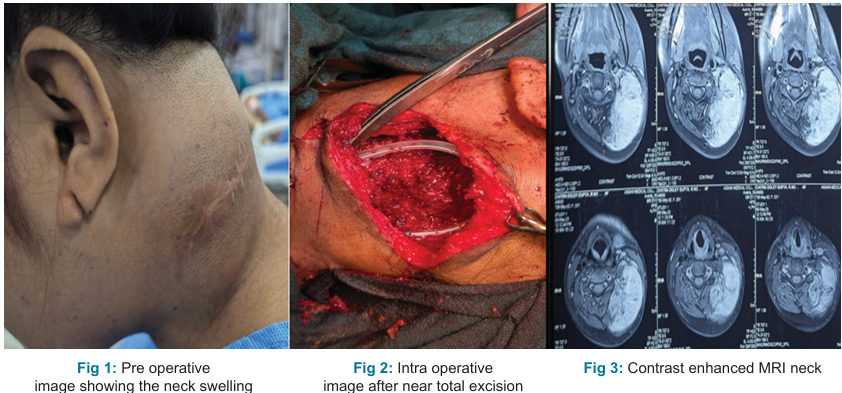
Introduction: Inflammatory Myofibroblastic(IMT) Tumor is a rare low grade malignant mesenchymal tumor. Most frequently it involves lung and rarely involves head and neck region. The exact etiology is unknown, but recent molecular and genetic evidence suggests it is a true neoplasm rather than purely an inflammatory reaction. Diagnosis is mainly histopathological and surgery is the treatment of choice.case report: A 33-year-old female presented to us with asymptomatic large soft tissue mass in the left posterior triangle of the neck for 2 years, which is diagnosed histopathologically as low grade myofibroblastic sarcoma, underwent near total excision, post of HPE report came as inflammatory myofibroblastic tumour, currently patient is on follow up without any recurrence.conclusion: Inflammatory myofibroblastic tumor, although a rare soft tissue tumor of head and neck region, but it is locally destructive, and can be confused with other tumors or malignancies because of its nonspecific clinical and radiological presentation. So, clinician should always keep in mind about this rare entity, and if diagnosed correctly then the patient can be cured of the condition just by surgical excision.
Keywords:Soft tissue tumour, Neck
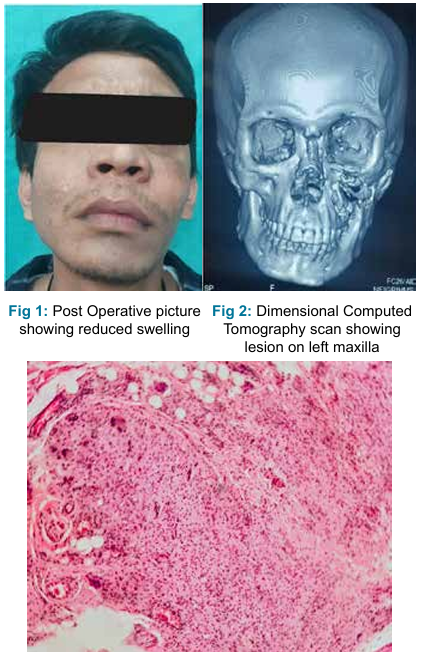
Xanthogranulomatous Inflammation of the Maxilla Mimicking a Dentigerous Cyst: A Rare Case Report
Nongthombam Bidyananda Singh, Manu CB, Nayana Sarma, Anuradha Deka, Suvamoy Chakraborty, Biswajit Dey

Xanthogranulomatous inflammation is a chronic inflammatory condition rarely encountered in the head and neck region. We presented here Xanthogranulomatous inflammation involving the maxilla in a 33 -year -old male.
Key words: Xanthogranulomatous inflammation, chronic inflammation, maxilla.
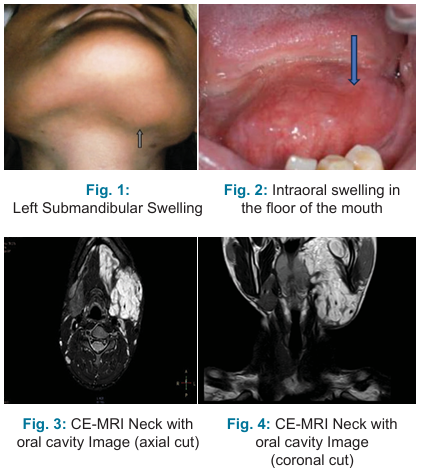
Plexiform Neurofibroma- a rare tumor of submandibular salivary gland
Arupjyoti Sharma, Utpal Sharma, Daradi Deka, Kallol Kakoti

Plexiform neurofibroma is more commonly seen in the orbit, neck, back, and inguinal region. It is extremely rare in the submandibular gland. These lesions rarely transform into malignancy but are locally infiltrative and can lead to haemorrhage. Therefore, plexiform neurofibroma should always be considered during differential diagnosis while excising a submandibular gland mass. We present here a case of plexiform neurofibroma in the submandibular gland and diffuse neurofibroma in the floor of the mouth in a 15-year-old male, not associated with neurofibromatosis-1.
Keywords: mouth, neurofibroma, Plexiform, submandibular gland.
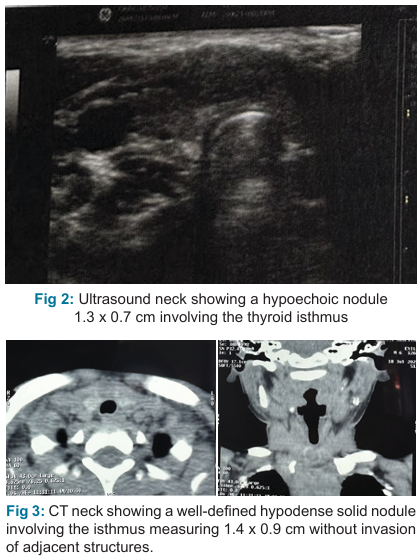
We report a case of papillary thyroid carcinoma in a 6-year-old male child who presented with a solitary midline thyroid nodule initially diagnosed as adenomatous goiter on fine needle aspiration cytology. Our case highlights the need for careful preoperative workup, management and follow-up of such cases in the pediatric age group.
Keywords: Solitary thyroid nodule, papillary thyroid carcinoma and pediatric age group
Nasa Shareera: review of anatomy of nose in ayurveda
Jyotirmoy Sarmah, Dipti Rekha Sarma

Problems of nose and paranasal sinuses are amongst the frequent reasons for patients’ visits to primary care as well as E.N.T. speciality clinics. Ayurveda, which means ‘the science of life’ in Sanskrit, is one of the oldest practised medical systems of the world, originating in India some 5000 years ago. Diseases of nose and paranasal sinuses, together with those of ear and throat, have been delineated alongside Oro-dentistry, diseases related to head and neck region and also Ophthalmology, in the specialized branch of Ayurveda termed as Shalakya Tantra, which is one of the original eight branches of Ayurveda, i.e. Astanga Ayurveda. In recent years the subject of Shalakya Tantra has been recognized into subspecialities, of which the diseases of ear, nose and throat alongside oro-dentistry, have been embodied in Karna-Nasa- Mukha rogas. The Ayurvedic equivalent of modern Anatomy is Shareera Rachana, the branch dealing with the structural aspects of human body; as such anatomy of nose in Ayurveda is dealt with in Nasa Shareera. From many scattered references in the various Ayurvedic classics, Nasa Shareera can be delineated vis-à-vis the Historical Review, Embryology, Anatomical parts, Characteristics of an ideal nose, as well as the consideration of nose as the Gateway to the structures of the Head and Neck, by virtue of which, a specialized therapy called Nashya Karma (intranasal drug delivery) is employed in Ayurveda to nourish and treat lesions of nose, paranasal sinuses as well as other vital structures located in the head and neck region of human body, viz. ear, throat, brain, eyes and surrounding areas.
Keywords:– Ayurveda, Shalakya Tantra, Karna-Nasa-Mukha, Nasa Shareera
Scroll to Top